 What is a Cube Root?
Contents
The cube root of a number is the number that multiplied by itself three times that will equal the original number. For example, the cubed root of 27 is 3 because 3 x 3 x 3 = 27.
To understand cube root, firstly understand about square and cube. A square of a number is the number multiply by itself two times like a2 = a a. A cube of a number is the number multiply by itself three times like a3 = a a a. Cube root is opposite of cube of a number.
The Cube Root Symbol
Cube roots are represented by the symbol ∛. To find the cube root of a number we have to find that number, whose three times multiplication by itself gives the number for which we have to find the cube root and therefore the number that multiplied by itself three times is the cube root of the given number.
How to Find the Cube Root of X
For example, Find the cube root of ‘y’ or can say find ∛y
y can be written as y1 and 1 can be written as 1/3 + 1/3 + 1/3
y
= y1
= y1/3 + 1/3 + 1/3
According to the product rule of exponents, when multiplying two or more numbers that have the same base, exponents add with each other vice versa we can separate the exponents that are in the addition form for the same base.
= (y1/3)( y1/3)(y1/3)
Therefore, ∛y = y1/3
In power form, a cube root is represented by power 1/3.
Positive & Negative Cube Root Calculation Example
In Mathematics, Cube root of a number ‘x’ is a number ‘y’ implies that y3 = x.
For example:
We know that, (2)3 = 8
∛8 = ∛(2 x 2 x 2) = 2
Cube root of 8 is 2.
Besides multiplying two times in square and three times in cube there is one more difference in squares and cubes that is positive sign or negative sign. We know that ( – x – = +) but ( – x – x – = -).
Every positive number has two different square roots. One is positive and the other is negative for example:
√4. = +-2 but every positive number has only positive cube root.
For example ∛27 = ∛(3 x 3 x 3 ) = 3 while negative number has negative cube root for example: ∛27 = ∛(-3 x -3 x -3 ) = -3
But, Square root of a negative number does not exist. √-4 is an imaginary number as √-1 = i (an imaginary number) because the square of a negative or a positive number cannot be negative.
How to Solve Basic Cube Root Equations
Here is a table that shows some basic square root calculations along with their equations.
| Cube Root of | Equation | Cube Root Calculation |
|---|---|---|
| 1 | ∛1 = ∛(1 ×1 ×1) | 1 |
| 8 | ∛8 = ∛(2 ×2 ×2) | 2 |
| 27 | ∛27 = ∛(3 ×3 ×3) | 3 |
| 64 | ∛64 = ∛(4 ×4 ×4) | 4 |
| 125 | ∛125 = ∛(5 ×5 ×5) | 5 |
| 216 | ∛216 = ∛(6 ×6 ×6) | 6 |
| 343 | ∛343 = ∛(7 ×7 ×7) | 7 |
| 512 | ∛512 = ∛(8 ×8 ×8) | 8 |
| 729 | ∛729 = ∛(9 ×9 ×9) | 9 |
| 1000 | ∛1000 = ∛(10 ×10 ×10) | 10 |
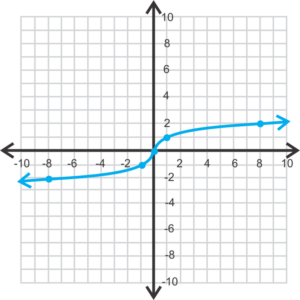
Cube Root Graph
When graphing cubed root functions, the graph forms an S shaped curve bisecting the x axis where the function equals zero. Here is an example cube root graph.