
 What is Completing the Square?
Contents
Definition: Completing the square is a method used in algebra to solve a quadratic equation by converting a standard form equation ( ax2 + bx + c ) into a vertex form equation ( a(x-h)2 + k ) by changing the left side to a perfect square trinomial.
The vertex form is much easier to solve or find the zeros of quadratic equations than the standard form equation. It also helps to find the vertex (h, k) which would be the maximum or minimum of the equation.
How to Complete the Square Steps
Here are the completing the square steps and operations to solve a quadratic equation in algebra.
- Start by factoring out the a
- Move the c term to the other side of the equation.
- Use the b term in order to find a new c term that makes a perfect square. This is done by first dividing the b term by 2 and squaring the quotient and add to both sides of the equation.
- Find your h, the b term divided by two, for the perfect square.
- Set equation to zero.
Completing the Square Formula
The completing the square formula is calculated by converting the left side of a quadratic equation to a perfect square trinomial.
For example, if a ball is thrown and it follows the path of the completing the square equation x2 + 6x – 8 = 0.
The maximum height of the ball or when the ball it’s the ground would be answers that could be found when the equation is in vertex form. When you complete the square you can get the equation (x+3)2 – 17 = 0.
Solve by Completing the Square Examples
Example
The first example is going to be done with the equation from above since it has a coefficient of 1 so a = 1.
Let’s solve x2 + 6x – 8 = 0.
Step #1 – Move the c term to the other side of the equation using addition.
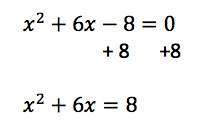
Step #2 – Use the b term in order to find a new c term that makes a perfect square. This is done by first dividing the b term by 2 and squaring the quotient.
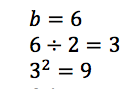
This number gets added to both sides of the equation to maintain the balance of the equation. What you do to one side, you do to the other side.
Step #3 – Simplify
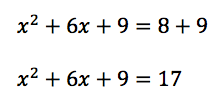
Your new perfect square, the h, is the b term divided by two. This is due to the fact that you are splitting that term into two parts.
x2 + 3x + 3x + 9 = (x+3)2
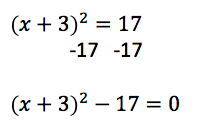
Step #4 – Last step is to set the equation to zero by using subtraction 2x2 + 20x + 8 = 0
Solving Quadratic Equations by Completing the Square
Example
Now let’s solve a quadratic equal by completing the square when a is not equal to zero.
Let’s start with the following equation: 2x2 + 20x + 8 = 0
Step #1 – Start by factoring out the a term, divide each term by 2
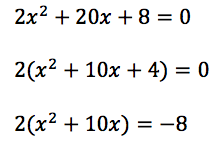
Step #2 – Move the c term to the other side of the equation using subtraction.
*You are not subtracting 4, but subtracting since the a term was factored out. Look back at the original equation, the c term is 8.
Step #3 – Find your new c term.
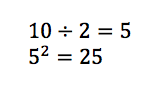
When adding the new c term to both sides, keep in mind that once more you need to multiply it by the factored a term.
2(x2 + 10x + 25) = -8 + 50
Simplify
2(x2 + 10x + 25 ) = 42
Step #4 – Your new perfect square, the h, is the b term divided by two. This is due to the fact that you are splitting that term into two parts.
x2 + 5x + 5x + 9 = (x + 5)2
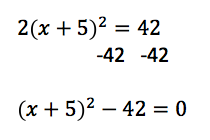
Step #5 – Set the equation to 0 by using subtraction
Completing the Square Worksheet
Sometimes it’s useful when learning a new concept or set of operations to use a worksheet. Here is a completing the square worksheet that you can download and practice solving a set of quadratic equations.
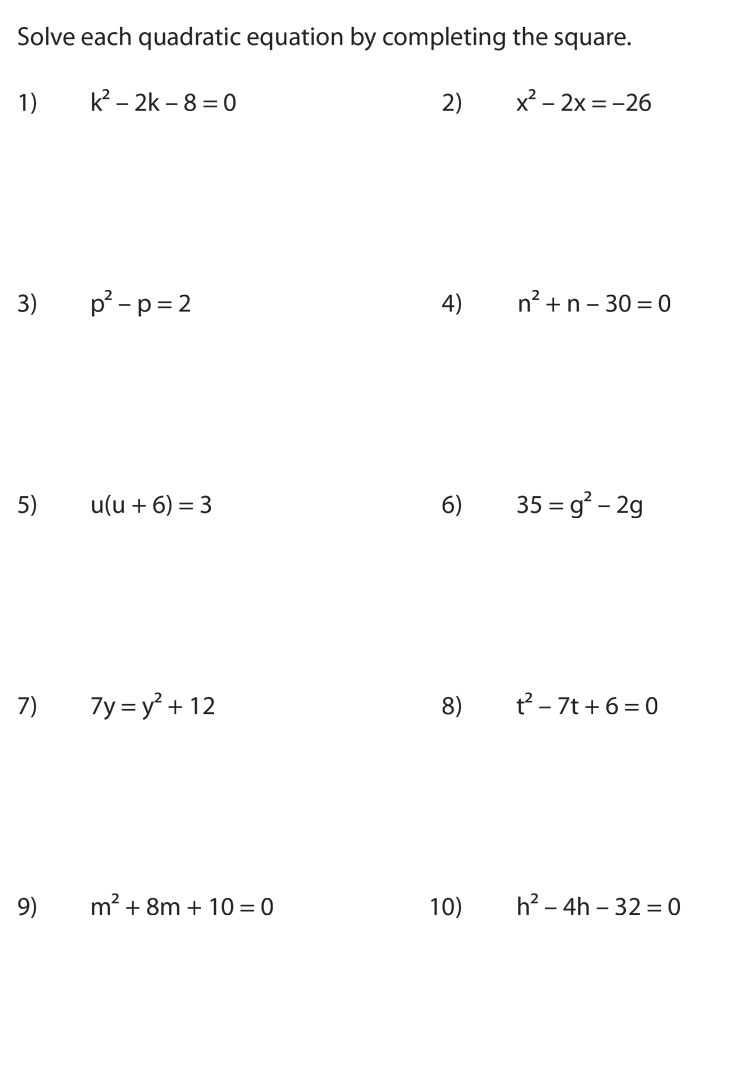
The answers to these problems are on this worksheet that you can download and check your work.
Why is Completing the Square Method Important?
By using completing the square method, a quadratic equation is in vertex form. It is easier to find the zeros of the equation in this form.
That information is often The starting point or ending point for many equation. For example, when an object is touching the ground.
It is also easy to find the vertex of the equation. The vertex is either the maximum point or the minimum point of the equation. This is great for when you want to find the maximum profit or volume given certain restraints.