
 What is an Isosceles Triangle?
Contents
Definition: An isosceles triangle is defined as a triangle having two congruent sides or two sides that are the same length.
An isosceles triangle can also be an equilateral triangle, but it doesn’t have to be.
Definitions for these triangles typically include the word “only” or “exactly”. These words make a difference when considering if a triangle is also an equilateral triangle as well as an isosceles triangle.
Isosceles Triangle Properties, Characteristics & Uses
Many triangles found in the real world can be considered isosceles, including a section of a slice of pizza. Often abstract or complicated shapes are broken into smaller shapes such as a triangle.
The two sides that are the same length are referred to as the legs and the third side is called the base. Oftentimes a problem will use this vocabulary to give information.
Knowing that an isosceles triangle has two sides that are equal leads us to the first theorem that is associated with isosceles triangles. Now let’s see how to find the missing sides of an isosceles triangle and calculate their lengths.
Isosceles Triangle Theorems
Theorem #1 – If two sides of a triangle are congruent, the angles opposite them are congruent.
This means that if we know that two sides are congruent in a triangle, we know that two angles are congruent as well. To find the opposite angle you want to look at the angle that the side is not a part of.
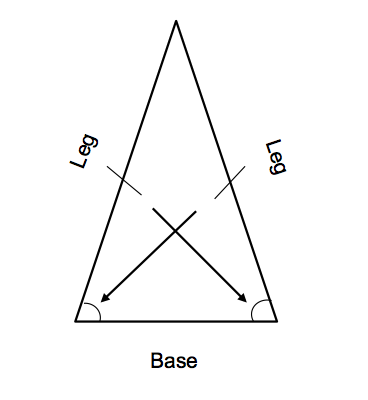
The single lines on the legs of the isosceles triangles are tick marks indicating that the sides have the same length, or are congruent. The arcs that are in the angles are indicating that the angles have the same measure, or are congruent. Notice that the base of the triangle is created by both angles that are congruent.
The converse of this theorem looks at the reverse.
Theorem #2 (converse) – If two angles of a triangle are congruent, the sides opposite them are congruent.
If we know that two angles are congruent, or have the same measure, than we know that the opposite sides are congruent, or have the same length.
Once more the congruent angles form the base and the congruent sides are the legs.
These two theorems are important for any proofs that ask you to prove a triangle is an isosceles triangle.
Make sure to note the definition given to you for what an isosceles triangle is. Some definitions allow for you to prove that two angles are congruent, some need the extra step to show that two sides are congruent.
Isosceles Triangle Problem Solutions
One of the common problems that involve an isosceles triangle includes an altitude drawn to the base. An altitude is a line that is drawn from the vertice of one angle to the opposite side forming a right angle.
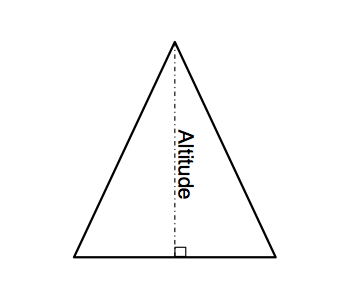
When an altitude is drawn to the base of an isosceles triangle, it forms two congruent triangles. The type of triangle and where the altitude is drawn is important. Let’s take a close look at this concept.
When we are given an isosceles triangle we know the following facts.
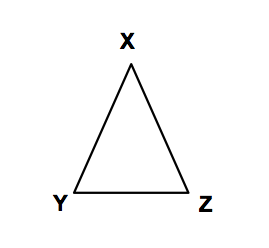
An isosceles triangle has two sides that are congruent (definition of an isosceles triangle). This will often be given to you by the given labeling of the base. If YZ is the base then we know XY ≅ XZ.
Since we know which sides are congruent, we now know what angles are congruent. ∠Y ≅ ∠Z (If two sides of a triangle are congruent, the angles opposite them are congruent).
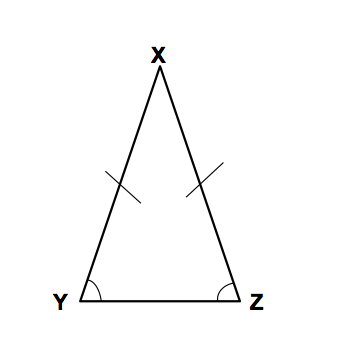
Now let’s draw in the altitude from angle X to the base. This splits the original isosceles triangle into two smaller right triangles.
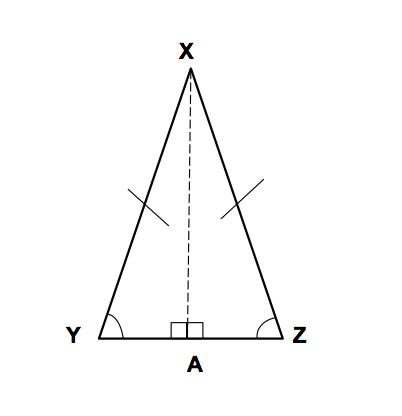
Since two right angles have the same measure (90 degrees), we can say that the right angles are congruent. This gives the missing piece to prove that by △XYA ≅ △XZA by AAS.
Isosceles Triangle Example Problems
Isosceles Triangle Problem Theorem #1
How to find the side of an isosceles triangle value of x equation.
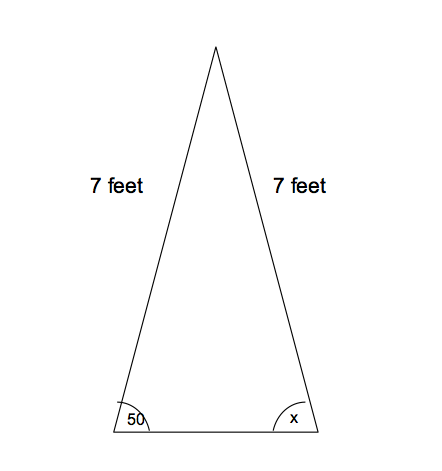
Notice that the two legs of a triangle are the same length, or congruent. This means that the opposite angles are congruent. Since one of the angles that is opposite the leg is 50 degrees, that means that the missing value is also 50 degrees.
Isosceles Triangle Problem Theorem #2
Let’s take a look at an example problem that would use this.
Find the value of y.
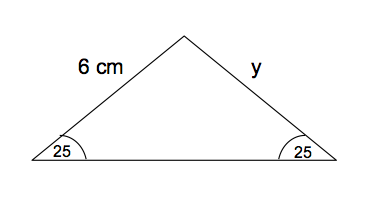
We can see that two of the angles are equal to 25 degrees. Since they are the same measure, we know that the sides opposite the angles are equal in measure as well. Once of the side lengths is labeled as 6 cm. We know that the other side must also be 6 cm. So the value of y is 6 cm.
Example:
Given triangle ABC is an isosceles triangle with base BC, find the measure of angle A.
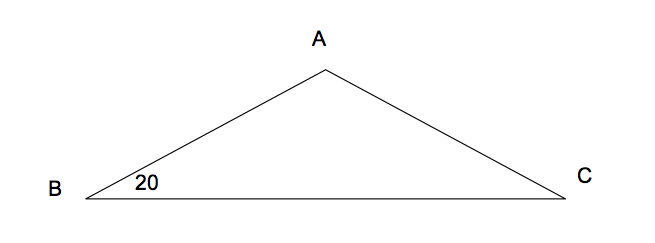
The information given can help us label the diagram more. We know that the triangle is an isosceles with a base of BC. This means that AB and AC are the legs and are congruent. This also means that the opposite angles are congruent. Since one angle is labeled as 20, we can label angle C, the angle opposite AB, as 20 as well.
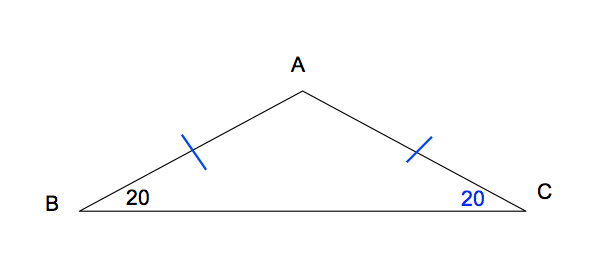
The information that is missing is that the sum of the angles of a triangle is 180°. With that knowledge we can finish finding the measure of angle A.
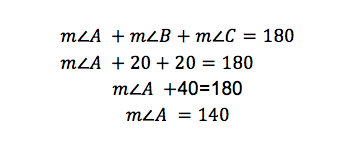
The measure of angle A is 140°